Showing posts with label With. Show all posts
 Antique Phonograph,Antique Phonograph With Pc Recording Product onhttp://sc01.alicdn.com/kf/HTB1hsfQJFXXXXcaXFXXq6xXFXXXW/Antique-phonograph-with-pc-recording-retro-bluetooth.jpg
Akai (recording) antique phonograph
The phonograph is a tool invented in 1877 for the mechanised duplication and taking of audio. In its later forms it is also called a gramophone (as a trademark since 1887, as a generic name since c. 1900). The audio vibration waveforms are saved as matching physical deviations of your spiral groove engraved, etched, incised, or impressed into the surface of the revolving cylinder or disk, called a "record". To recreate the sound, the top is similarly rotated while a playback stylus traces the groove which is therefore vibrated because of it, very reproducing the registered audio faintly. In early acoustic phonographs, the stylus vibrated a diaphragm which produced sound waves which were coupled to the open air by way of a flaring horn, or directly to the listener's ears through stethoscope-type earphones. In later electric phonographs (also called record players (since 1940s) or, most recently, turntables), the movements of the stylus are changed into an analogous electrical signal with a transducer, then changed back to audio by way of a loudspeaker.
The phonograph was invented in 1877 by Thomas Edison. While other inventors possessed produced devices that could record may seem, Edison's phonograph was the first ever to have the ability to reproduce the noted sound. His phonograph originally recorded audio onto a tinfoil sheet wrapped around a spinning cylinder. A stylus responding to sound vibrations produced an and down or hill-and-dale groove in the foil up. Alexander Graham Bell's Volta Laboratory made several improvements in the 1880s, including the use of wax-coated cardboard cylinders, and a cutting stylus that moved laterally in a "zig zag" groove across the record.
Inside the 1890s, Emile Berliner initiated the change from phonograph cylinders to chiseled discs with a spiral groove running from the periphery to near to the center. Later advancements through the entire years included alterations to the turntable and its own drive system, the needle or stylus, and the equalization and sound systems.
The disc phonograph record was the prominent audio taking format throughout most of the 20th century. From the mid-1980s on, phonograph use on a standard record player declined sharply as a result of rise of the cassette tape, compact disk and other digital tracking formats. Records are a well liked format for a few audiophiles and DJs still. Vinyl records are still employed by some DJs and musicians in their concert performances. Musicians continue steadily to release their recordings on vinyl records. The original recordings of musicians are re-issued on vinyl sometimes.
Usage of terminology is not standard across the English-speaking world (see below). In newer usage, the playback device is often called a "turntable", "record player", or "record changer". When used in conjunction with a mixing machine within a DJ installation, turntables tend to be called "decks".
The term phonograph ("sound writing") was derived from the Greek words ???? (phon?, "sound" or "voice") and ????? (graph?, "writing"). The similar related terms gramophone (from the Greek ?????? gramma "notice" and ???? ph?n? "voice") and graphophone have similar root meanings. The origins were already familiar from existing 19th-century words such as picture ("light writing"), telegraph ("distant writing"), and cell phone ("distant sound"). The new term might have been influenced by the existing words phonographic and phonography, which described something of phonetic shorthand; in 1852 THE BRAND NEW York Times taken an ad for "Professor Webster's phonographic class", and in 1859 the brand new York State Professors Relationship tabled a motion to "employ a phonographic recorder" to record its meetings.
Arguably, any device used to track record audio or reproduce saved sound could be called a type of "phonograph", however in common practice the indicated phrase has come to indicate historical technologies of audio documenting, regarding audio-frequency modulations of the physical trace or groove.
In the past due 19th and early on 20th hundreds of years, "Phonograph", "Gramophone", "Graphophone", "Zonophone" and so on were still brand names specific to various designers of sometimes completely different (i.e. cylinder and disk) machines; so substantial use was manufactured from the general term "talking machine", in print especially. "Talking machine" had earlier been used to refer to complicated devices which produced a crude imitation of speech, by simulating the workings of the vocal cords, tongue, and lips - a potential source of bafflement both and today then.
In British English, "gramophone" may make reference to any sound-reproducing machine using disc records, that have been popularized and released in the UK by the Gramophone Company. Originally, "gramophone" was a proprietary trademark of this company and any use of the name by competing makers of disc records was vigorously prosecuted in the courts, but in 1910 an English court decision decreed that it had turn into a generic term; it's been so used in the UK and most Commonwealth countries ever since. The term "phonograph" was usually restricted to machines that used cylinder records.
"Gramophone" generally described a wind-up machine. After the benefits of the softer vinyl fabric information, 33 1/3-rpm LPs (long-playing files) and 45-rpm "single" or two-song files, and EPs (extended-play recordings), the common name became "record player" or "turntable". Usually the home record player was part of something that included a radio (radiogram) and, later, may also play audiotape cassettes. From about 1960, such a system began to be described as a "hi-fi" (high-fidelity, monophonic) or a "stereo" (most systems being stereophonic by the mid-1960s).
In Australian English, "record player" was the term; "turntable" was a far more technological term; "gramophone" was restricted to the old mechanised (i.e., wind-up) players; and "phonograph" was used as with British English.
Horn or Gramophone w Horn Record Player Phonograph 78RPM Antique Style
 http://thekingsbay.com/image/cache/catalog/Products/Home%20Decor/round%20gramophone%20a3-700x1000.jpg
Vintage Antique Victrola Phonograph Record Player Ask About Old Radio
 http://i.ebayimg.com/images/i/391209697123-0-1/s-l1000.jpg
Vintage Cavalcade Phonograph Turntable Record Player on PopScreen
 http://img0102o.psstatic.com/157150497_vintage-cavalcade-phonograph-turntable-record-player.jpg
Victrola Antique Phonograph Record Player Harp Gallery Antique
 http://www.harpgallery.com/extimg/r3/1024__1024____er__phono1431vic.jpg
OIP.M772052b29e5c335a333e1877cb0c4f14o0
69C6E12B1D18DE2CC4649F6697EA44D82497D46D7http://www.alibaba.com/product-detail/Antique-phonograph-with-pc-recording-retro_60459476323.html
Embed Our image to your website
ThumbnailImageEmbed Our image to a Forum
ThumbnailImage
Antique Phonograph,Antique Phonograph With Pc Recording Product on
 Micro Dd5 Working Properly Turntable Record Player With Ff15x MkⅡfhttp://www.collectiblesforanything.com/pic/262504449076_1.jpg
Denon antique phonograph
The phonograph is a device developed in 1877 for the mechanical taking and duplication of sound. In its later forms additionally it is called a gramophone (as a trademark since 1887, as a generic name since c. 1900). The sound vibration waveforms are saved as corresponding physical deviations of a spiral groove imprinted, etched, incised, or impressed in to the surface of the spinning disc or cylinder, called a "record". To recreate the audio, the top is similarly rotated while a playback stylus traces the groove and it is therefore vibrated by it, very faintly reproducing the saved audio. In early acoustic phonographs, the stylus vibrated a diaphragm which produced sound waves that have been coupled to the open air by having a flaring horn, or right to the listener's ears through stethoscope-type earphones. In later electric phonographs (also called record players (since 1940s) or, lately, turntables), the motions of the stylus are changed into an analogous electric signal by the transducer, then altered back to audio by way of a loudspeaker.
The phonograph was created in 1877 by Thomas Edison. While other inventors had produced devices that can record looks, Edison's phonograph was the first ever to have the ability to reproduce the noted sound. His phonograph actually recorded sound onto a tinfoil sheet wrapped around a spinning cylinder. A stylus giving an answer to appear vibrations produced an and down or hill-and-dale groove in the foil up. Alexander Graham Bell's Volta Laboratory made several improvements in the 1880s, including the use of wax-coated cardboard cylinders, and a cutting stylus that moved from side to side in a "zig zag" groove surrounding the record.
Within the 1890s, Emile Berliner initiated the change from phonograph cylinders to chiseled discs with a spiral groove operating from the periphery to nearby the center. Later improvements through the entire years included alterations to the turntable and its own drive system, the stylus or needle, and the audio and equalization systems.
The disk phonograph record was the prominent audio saving format throughout almost all of the 20th century. Through the mid-1980s on, phonograph use on a standard record player declined sharply because of the rise of the cassette tape, compact disk and other digital saving formats. Details remain a favorite format for some audiophiles and DJs. Vinyl records are used by some DJs and musicians in their concert performances still. Musicians continue steadily to release their recordings on vinyl records. The original recordings of musicians are occasionally re-issued on vinyl fabric.
Using terminology is not uniform across the English-speaking world (see below). In more modern usage, the playback device is named a "turntable", "record player", or "record changer". When found in conjunction with a mixer within a DJ set up, turntables tend to be called "decks".
The word phonograph ("sound writing") was produced from the Greek words ???? (phon?, "sound" or "voice") and ????? (graph?, "writing"). The similar related conditions gramophone (from the Greek ?????? gramma "notice" and ???? ph?n? "tone") and graphophone have similar main meanings. The root base were already familiar from existing 19th-century words such as picture ("light writing"), telegraph ("distant writing"), and phone ("distant sound"). The brand new term might have been inspired by the prevailing words phonographic and phonography, which described something of phonetic shorthand; in 1852 THE BRAND NEW York Times transported an advertisement for "Professor Webster's phonographic class", and in 1859 the brand new York State Instructors Connection tabled a action to "employ a phonographic recorder" to record its meetings.
Probably, any device used to record sound or reproduce noted sound could be called a kind of "phonograph", but in common practice the portrayed expression has come to signify historical solutions of sound recording, concerning audio-frequency modulations of an physical groove or trace.
In the overdue 19th and early 20th hundreds of years, "Phonograph", "Gramophone", "Graphophone", "Zonophone" and so on were still brand names specific to various producers of sometimes very different (i.e. cylinder and disc) machines; so appreciable use was made of the universal term "talking machine", especially in print. "Talking machine" had earlier been used to make reference to complicated devices which produced a crude imitation of speech, by simulating the workings of the vocal cords, tongue, and lip area - a potential way to obtain misunderstanding both and now then.
In British English, "gramophone" may refer to any sound-reproducing machine using disc records, that have been created and popularized in the united kingdom by the Gramophone Company. Originally, "gramophone" was a proprietary trademark of that company and any use of the name by competing makers of disc records was vigorously prosecuted in the courts, but in 1910 an English court decision decreed so it had become a generic term; it's been so used in the UK & most Commonwealth countries ever since. The term "phonograph" was usually limited to machines that used cylinder records.
"Gramophone" generally referred to a wind-up machine. Following the benefits of the softer vinyl information, 33 1/3-rpm LPs (long-playing information) and 45-rpm "single" or two-song data, and EPs (extended-play recordings), the common name became "record player" or "turntable". Usually the home record player was part of something that included a radio (radiogram) and, later, might play audiotape cassettes also. From about 1960, such something began to be described as a "hi-fi" (high-fidelity, monophonic) or a "stereo" (most systems being stereophonic by the mid-1960s).
In Australian British, "record player" was the term; "turntable" was a far more specialized term; "gramophone" was restricted to the old mechanised (i.e., wind-up) players; and "phonograph" was used such as British English.
Denon Dp500m Direct Drive Turntable Analogue Record Player New From
 http://www.gogogretchen.com/file/261973703845_1.jpg
Phonograph manufacturers
 http://www.antiquephono.org/wp-content/uploads/2014/06/Nightingale-July-1919.jpg
Vintage Telefunken Phonograph Turntable Record Player For Parts
 http://i.ebayimg.com/00/s/NzY4WDEwMjQ=/z/mVkAAOSw34FVIs5U/$_35.JPG?set_id=880000500F
Rare Antique Flemish Phonograph Co. Turntable Phonograph Record Player
 http://www.collectibleentertainmentprops.com/gif/221980999039_1.jpg
OIP.M1d00527b270980ac0c00843d5ef5cc47o0
2C90B43A2ABEE0253F8D2D24DE894AD287F41949Ehttp://www.collectiblesforanything.com/edison-part/phonograph-recorder.html
Embed Our image to your website
ThumbnailImageEmbed Our image to a Forum
ThumbnailImage
Micro Dd5 Working Properly Turntable Record Player With Ff15x MkⅡf
 Antique Edison Standard Phonograph Record Player With Wood Cover Workshttp://www.collectiblesforthepeople.com/thumbs/800/262287535659_1.jpg
analogueworks antique phonograph
The phonograph is a device developed in 1877 for the mechanised tracking and reproduction of sound. In its later forms additionally it is called a gramophone (as a trademark since 1887, as a generic name since c. 1900). The audio vibration waveforms are noted as equivalent physical deviations of a spiral groove imprinted, etched, incised, or impressed into the surface of any rotating disc or cylinder, called a "record". To recreate the audio, the top is similarly rotated while a playback stylus traces the groove and is therefore vibrated by it, very reproducing the documented sound faintly. In early acoustic phonographs, the stylus vibrated a diaphragm which produced sound waves which were coupled to the open air by way of a flaring horn, or directly to the listener's ears through stethoscope-type earphones. In later electric phonographs (also called record players (since 1940s) or, most recently, turntables), the movements of the stylus are converted into an analogous electric powered signal by the transducer, then altered back to sound with a loudspeaker.
The phonograph was invented in 1877 by Thomas Edison. While other inventors got produced devices that could record sounds, Edison's phonograph was the first to have the ability to reproduce the recorded sound. His phonograph formerly recorded audio onto a tinfoil sheet covered around a rotating cylinder. A stylus responding to appear vibrations produced an and down or hill-and-dale groove in the foil up. Alexander Graham Bell's Volta Laboratory made several improvements in the 1880s, like the use of wax-coated cardboard cylinders, and a cutting stylus that moved from side to side in a "zig zag" groove round the record.
Within the 1890s, Emile Berliner initiated the transition from phonograph cylinders to chiseled discs with a spiral groove operating from the periphery to nearby the center. Later improvements over time included improvements to the turntable and its drive system, the needle or stylus, and the equalization and sound systems.
The disk phonograph record was the dominant audio saving format throughout the majority of the 20th century. In the mid-1980s on, phonograph use on a standard record player declined sharply due to rise of the cassette tape, compact disc and other digital tracking formats. Information remain a popular format for a few audiophiles and DJs. Vinyl records are being used by some DJs and musicians in their concert performances still. Musicians continue to release their recordings on vinyl records. The initial recordings of musicians are occasionally re-issued on vinyl.
Using terminology is not homogeneous over the English-speaking world (see below). In more modern usage, the playback device is categorised as a "turntable", "record player", or "record changer". When found in conjunction with a mixing machine as part of a DJ installation, turntables are often called "decks".
The word phonograph ("sound writing") was derived from the Greek words ???? (phon?, "sound" or "voice") and ????? (graph?, "writing"). The similar related conditions gramophone (from the Greek ?????? gramma "letter" and ???? ph?n? "voice") and graphophone have similar main meanings. The origins were already familiar from existing 19th-century words such as picture ("light writing"), telegraph ("distant writing"), and phone ("distant sound"). The new term may have been inspired by the prevailing words phonographic and phonography, which described something of phonetic shorthand; in 1852 THE BRAND NEW York Times transported an ad for "Professor Webster's phonographic class", and in 1859 the brand new York State Professors Connection tabled a motion to "hire a phonographic recorder" to record its meetings.
Arguably, any device used to record sound or reproduce recorded audio could be called a type of "phonograph", however in common practice the portrayed word has come to signify traditional systems of audio documenting, involving audio-frequency modulations of a physical groove or trace.
In the past due 19th and early 20th hundreds of years, "Phonograph", "Gramophone", "Graphophone", "Zonophone" and so on were still brand names specific to various creators of sometimes very different (i.e. cylinder and disc) machines; so appreciable use was made of the general term "talking machine", in print especially. "Talking machine" had earlier been used to refer to complicated devices which produced a crude imitation of speech, by simulating the workings of the vocal cords, tongue, and mouth - a potential source of misunderstandings both and today then.
In British English, "gramophone" may make reference to any sound-reproducing machine using disk records, which were popularized and launched in the united kingdom by the Gramophone Company. Originally, "gramophone" was a proprietary trademark of this company and any use of the name by competing makers of disc records was vigorously prosecuted in the courts, but in 1910 an English court decision decreed that it had turn into a generic term; it's been so used in the UK & most Commonwealth countries since. The word "phonograph" was usually restricted to machines which used cylinder records.
"Gramophone" generally described a wind-up machine. After the introduction of the softer vinyl fabric documents, 33 1/3-rpm LPs (long-playing records) and 45-rpm "single" or two-song documents, and EPs (extended-play recordings), the normal name became "record player" or "turntable". Often the home record player was part of a system that included a radio (radiogram) and, later, may also play audiotape cassettes. From about 1960, such a system began to be described as a "hi-fi" (high-fidelity, monophonic) or a "stereo" (most systems being stereophonic by the mid-1960s).
In Australian English, "record player" was the word; "turntable" was a more complex term; "gramophone" was limited to the old mechanised (i.e., wind-up) players; and "phonograph" was used as with British English.
Antique Edison Standard Phonograph Record Player Horn Attachment Works
 http://www.gogogretchen.com/file/171835170170_1.jpg
Disc Wood Antiques amp; Other Rare Collectibles
 http://www.antiquesandrarecollectiblesonline.com/pics/391384675550_1.jpg
Edison Cylinder Phonograph With 14 Horn, Plays Well Machine Record
 http://www.gogogretchen.com/file/261948867092_1.jpg
Vintage Oem Rca Victor Ap1 Auto Car Truck Automobile 45 Record Player
 http://www.gogogretchen.com/file/261972637371_1.jpg
OIP.M9d0310b116df111aefe3f2b4b5282ab6o0
2ACC40EE41018DEAEC2C25D5DEF2313C3BA3DA5DChttp://collectiblesforthepeople.com/record-player-151-tc/record-player.html
Embed Our image to your website
ThumbnailImageEmbed Our image to a Forum
ThumbnailImage
Antique Edison Standard Phonograph Record Player With Wood Cover Works
 Start With A “Bang”! Sell, Lead, Succeed!http://sellleadsucceed.files.wordpress.com/2013/05/bigstock-bang-13050143.jpg
Bang & Olufsen antique phonograph
The phonograph is a device developed in 1877 for the mechanised duplication and taking of audio. In its later forms it is also called a gramophone (as a trademark since 1887, as a generic name since c. 1900). The audio vibration waveforms are recorded as matching physical deviations of any spiral groove etched, etched, incised, or impressed into the surface of any revolving disk or cylinder, called a "record". To recreate the sound, the top is in the same way rotated while a playback stylus traces the groove and is therefore vibrated by it, very reproducing the saved sound faintly. In early acoustic phonographs, the stylus vibrated a diaphragm which produced sound waves that have been coupled to the open air by using a flaring horn, or right to the listener's ears through stethoscope-type earphones. In later electric phonographs (also called record players (since 1940s) or, most recently, turntables), the movements of the stylus are converted into an analogous electric powered signal by a transducer, changed back to audio by the loudspeaker then.
The phonograph was created in 1877 by Thomas Edison. While other inventors experienced produced devices that can record tones, Edison's phonograph was the first ever to be able to reproduce the saved sound. His phonograph actually recorded sound onto a tinfoil sheet twisted around a spinning cylinder. A stylus responding to acoustics vibrations produced an up and down or hill-and-dale groove in the foil. Alexander Graham Bell's Volta Laboratory made several improvements in the 1880s, including the use of wax-coated cardboard cylinders, and a cutting stylus that moved from side to side in a "zig zag" groove around the record.
In the 1890s, Emile Berliner initiated the transition from phonograph cylinders to even discs with a spiral groove running from the periphery to near to the center. Later advancements through the years included changes to the turntable and its own drive system, the stylus or needle, and the sound and equalization systems.
The disk phonograph record was the dominating audio taking format throughout the majority of the 20th hundred years. In the mid-1980s on, phonograph use on a standard record player declined sharply as a result of rise of the cassette tape, compact disc and other digital recording formats. Data remain a favorite format for a few audiophiles and DJs. Vinyl records are still utilized by some DJs and musicians in their concert performances. Musicians continue to release their recordings on vinyl records. The initial recordings of music artists are re-issued on vinyl fabric sometimes.
Usage of terminology is not standard over the English-speaking world (see below). In newer usage, the playback device is categorised as a "turntable", "record player", or "record changer". When found in conjunction with a mixing machine within a DJ setup, turntables tend to be called "decks".
The word phonograph ("sound writing") was derived from the Greek words ???? (phon?, "sound" or "voice") and ????? (graph?, "writing"). The similar related conditions gramophone (from the Greek ?????? gramma "letter" and ???? ph?n? "tone") and graphophone have similar root meanings. The root base were already familiar from existing 19th-century words such as picture ("light writing"), telegraph ("distant writing"), and phone ("distant sound"). The brand new term may have been inspired by the existing words phonographic and phonography, which described something of phonetic shorthand; in 1852 THE BRAND NEW York Times taken an advertising campaign for "Professor Webster's phonographic class", and in 1859 the brand new York State Teachers Association tabled a action to "employ a phonographic recorder" to record its meetings.
Probably, any device used to record sound or reproduce documented sound could be called a type of "phonograph", however in common practice the word has come to suggest ancient solutions of sound saving, relating audio-frequency modulations of your physical groove or track.
In the overdue 19th and early on 20th ages, "Phonograph", "Gramophone", "Graphophone", "Zonophone" and the like were still brand names specific to various creators of sometimes completely different (i.e. cylinder and disc) machines; so significant use was made of the generic term "talking machine", especially in print. "Talking machine" had earlier been used to make reference to complicated devices which produced a crude imitation of speech, by simulating the workings of the vocal cords, tongue, and mouth - a potential way to obtain misunderstanding both and now then.
In British English, "gramophone" may make reference to any sound-reproducing machine using disc records, which were introduced and popularized in the united kingdom by the Gramophone Company. Originally, "gramophone" was a proprietary trademark of that company and any use of the name by competing makers of disc records was vigorously prosecuted in the courts, however in 1910 an English court decision decreed that this had become a generic term; it's been so used in the united kingdom and most Commonwealth countries since. The term "phonograph" was usually restricted to machines that used cylinder records.
"Gramophone" generally described a wind-up machine. After the introduction of the softer vinyl records, 33 1/3-rpm LPs (long-playing details) and 45-rpm "single" or two-song files, and EPs (extended-play recordings), the normal name became "record player" or "turntable". Usually the home record player was part of something that included a radio (radiogram) and, later, might also play audiotape cassettes. From about 1960, such something began to be described as a "hi-fi" (high-fidelity, monophonic) or a "stereo" (most systems being stereophonic by the mid-1960s).
In Australian English, "record player" was the word; "turntable" was a far more complex term; "gramophone" was limited to the old mechanised (i.e., wind-up) players; and "phonograph" was used as in British English.
Comic Book Bang Clip Art at Clker.com vector clip art online
 http://www.clker.com/cliparts/G/V/5/g/3/j/comic-book-bang-hi.png
BIGBANG 뱅뱅뱅 BANG BANG BANG M/V YouTube
 https://i.ytimg.com/vi/2ips2mM7Zqw/hqdefault.jpg
ariana grande, bang bang, beauty, cute, love, music, my everything
 http://s2.favim.com/610/141012/ariana-grande-bang-bang-beauty-cute-Favim.com-2145732.jpg
The Big Bang Theory Bernadette Melissa Rauch
 https://blogger.googleusercontent.com/img/b/R29vZ2xl/AVvXsEh_RAmteOGWpHLYxcQKHkuZoKPCFf4YSTRXw_1CVvKFfPMkq1owirF32G3I1_VFj8cw9isHaj4cbnc3gGXbKUFNadoZkaFQrc8_Xxd8TKZjcvMDhWdP_EjVjbLIeRajOijk8QuC96gAFKY/s1600/The-Hot-Troll-Deviation-howard-bernadette-Melissa-Rauch.jpg
OIP.M2691fd1553c9fe355e1dc796dfb9af8co0
6B3F971358BF4A554487BCC138451EB864BF11253http://sellleadsucceed.com/2013/05/22/start-with-a-bang/
Embed Our image to your website
ThumbnailImageEmbed Our image to a Forum
ThumbnailImage
Start With A “Bang”! Sell, Lead, Succeed!
 Phonographs With Flair, A Century of Stylein SoundReproduction , 340http://www.phonophan.com/flaircover.jpg
analogueworks antique phonograph
The phonograph is a tool developed in 1877 for the mechanised recording and duplication of audio. In its later forms additionally it is called a gramophone (as a trademark since 1887, as a generic name since c. 1900). The audio vibration waveforms are recorded as corresponding physical deviations of any spiral groove imprinted, etched, incised, or impressed into the surface of the spinning disk or cylinder, called a "record". To recreate the sound, the top is in the same way rotated while a playback stylus traces the groove which is therefore vibrated by it, very reproducing the noted audio faintly. In early acoustic phonographs, the stylus vibrated a diaphragm which produced sound waves that have been coupled to the open air by using a flaring horn, or directly to the listener's ears through stethoscope-type earphones. In later electric phonographs (also called record players (since 1940s) or, most recently, turntables), the motions of the stylus are changed into an analogous electric signal with a transducer, then changed back into audio with a loudspeaker.
The phonograph was invented in 1877 by Thomas Edison. While other inventors experienced produced devices that could record sounds, Edison's phonograph was the first to have the ability to reproduce the registered sound. His phonograph actually recorded sound onto a tinfoil sheet wrapped around a spinning cylinder. A stylus responding to acoustics vibrations produced an up and down or hill-and-dale groove in the foil. Alexander Graham Bell's Volta Laboratory made several improvements in the 1880s, like the use of wax-coated cardboard cylinders, and a cutting stylus that moved from side to side in a "zig zag" groove across the record.
Within the 1890s, Emile Berliner initiated the transition from phonograph cylinders to toned discs with a spiral groove operating from the periphery to close to the center. Later improvements over time included adjustments to the turntable and its own drive system, the needle or stylus, and the audio and equalization systems.
The disk phonograph record was the prominent audio saving format throughout almost all of the 20th hundred years. From mid-1980s on, phonograph use on a standard record player declined sharply as a result of rise of the cassette tape, compact disc and other digital taking formats. Documents are still a favorite format for a few audiophiles and DJs. Vinyl records are still employed by some DJs and musicians in their concert performances. Musicians continue steadily to release their recordings on vinyl records. The original recordings of musicians are re-issued on vinyl sometimes.
Using terminology is not standard over the English-speaking world (see below). In newer usage, the playback device is categorised as a "turntable", "record player", or "record changer". When used in conjunction with a mixing machine as part of a DJ setup, turntables are often called "decks".
The word phonograph ("sound writing") was produced from the Greek words ???? (phon?, "sound" or "voice") and ????? (graph?, "writing"). The similar related terms gramophone (from the Greek ?????? gramma "notice" and ???? ph?n? "tone") and graphophone have similar root meanings. The root base were already familiar from existing 19th-century words such as photograph ("light writing"), telegraph ("distant writing"), and phone ("distant sound"). The brand new term might have been inspired by the prevailing words phonographic and phonography, which referred to something of phonetic shorthand; in 1852 THE BRAND NEW York Times taken an advertising campaign for "Professor Webster's phonographic class", and in 1859 the brand new York State Teachers Connection tabled a action to "employ a phonographic recorder" to track record its meetings.
Arguably, any device used to record sound or reproduce recorded sound could be called a kind of "phonograph", however in common practice the word has come to suggest traditional systems of reasonable tracking, regarding audio-frequency modulations of your physical groove or track.
In the past due 19th and early 20th hundreds of years, "Phonograph", "Gramophone", "Graphophone", "Zonophone" and so on were still brand names specific to various producers of sometimes very different (i.e. cylinder and disc) machines; so extensive use was manufactured from the universal term "talking machine", especially in print. "Talking machine" had earlier been used to refer to complicated devices which produced a crude imitation of speech, by simulating the workings of the vocal cords, tongue, and lips - a potential way to obtain confusion both then and now.
In British British, "gramophone" may refer to any sound-reproducing machine using disk records, that have been popularized and launched in the united kingdom by the Gramophone Company. Originally, "gramophone" was a proprietary trademark of this company and any use of the name by competing makers of disc records was vigorously prosecuted in the courts, but in 1910 an English court decision decreed that this had turn into a generic term; it's been so used in the UK and most Commonwealth countries ever since. The term "phonograph" was usually restricted to machines which used cylinder records.
"Gramophone" generally described a wind-up machine. Following the benefits of the softer vinyl records, 33 1/3-rpm LPs (long-playing files) and 45-rpm "single" or two-song files, and EPs (extended-play recordings), the normal name became "record player" or "turntable". Often the home record player was part of a system that included a radio (radiogram) and, later, might play audiotape cassettes also. From about 1960, such something began to certainly be a "hi-fi" (high-fidelity, monophonic) or a "stereo" (most systems being stereophonic by the mid-1960s).
In Australian British, "record player" was the term; "turntable" was a more technical term; "gramophone" was limited to the old mechanised (i.e., wind-up) players; and "phonograph" was used as with British English.
Antique Radio Forums • View topic Philco 471230 Phonograph
 http://i168.photobucket.com/albums/u166/jesserocket01/old%20time%20radios/WP_0005322.jpg
Dp500m Direct Drive Turntable Analogue Record Player New From Japan
http://www.gogogretchen.com/file/261973703845_1.jpgvintage radio repair Stereo Repair Denver
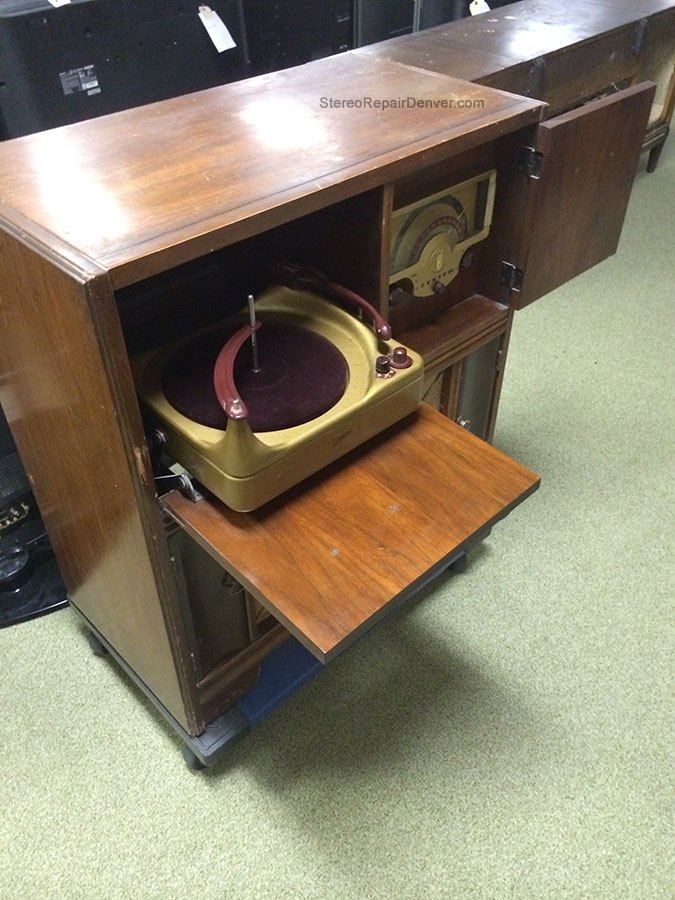 https://stereorepairdenver.files.wordpress.com/2014/08/zenith-vintage-tube-radio-fm-the-armstrong.jpg
: Repair Drive Belt Use Duct Tape Phonograph Cassette 8track etc
 https://i.ytimg.com/vi/FC_lCEPMvpw/mqdefault.jpg
OIP.M070fa0973fc331c59dc6f803b54bd656o0
103A89EBC20FE1983DFD0F07E325675821C3852448http://www.phonophan.com/products.html
Embed Our image to your website
ThumbnailImageEmbed Our image to a Forum
ThumbnailImage

